Number I site on autoimmune diseases

 
      Home
      Diagnosis
      Treatment
      Pathology
      Variants
      CIDP info
      GBS
        IVIG
        Diet
        About Us
        E-Book
        Email Web Weaver
        Autoimmune diseases
        News
        Links
        F.A.Q.
Clinics of Excellence

  Kidney stone removal   without surgery

Eliminate risk of heart disease & stroke 

Memory clinic

Depression & anxiety

Private treatment of addiction  & Drug Rehab

Sexual  disorders Clinic

Parkinson Clinic

Epilepsy Clinic

Pain Clinic

Bone disorders clinic

Joint disorder clinic

Skin repair clinic

Gene Manipulation

Neurology Clinic

TMJ CLINIC

We offer a lecture on personality development and self improvement.

Is your teenage child out of your control we do behavior modification treatment with positive results and a 90% turnaround.

Our Nanoparticle treatment units are for sale. Get your treatment at home.

Sex in autoimmune disease

Reduce weight

Drug reaction prevention

Prevent Osteoporosis

Some rheumatic disorders


 Skin repair Clinic
 Neck Pain
 Rabinder N Tagore
 Breast Lymph Drainage
 Osteoporosis
 Electronic Treatment
 Breast Size & Disease
 Female Sex Disease
 PARKINSON
 Memory problems
 Breast Lymph Drainage
 Kidney stone Buster
 Bras & breast cancer
 Lahore Clinic
 Lahore skin Clinic
 Pandas


Immunoglobulin A nephropathy & Fish Oils

IgA Nephropathy

PCR Testing for Mycoplasma and Chlamydia in CFS/MCS

Erectile Dysfunction, High Blood Pressure Linked

Quranic Shifa

Backpain

Fibromyalgia

Personality

Electrical Stimulation Therapy

Addison

Estrogen

DNA

Magnets and ageing

Heart solution

Immunodeficiency

Immunoglobulins

Vaccination

Sexual  disorders Clinic

Parkinson Clinic

Epilepsy Clinic

Pain Clinic

Bone disorders clinic

Joint disorder clinic

Skin repair clinic

Gene Manipulation

Neurology Clinic

TMJ CLINIC

Women issues

Women and heart disease

Female heart attack

Women stay younger

Ketogenic diet


Welcome to the Autoimmune Diseases


Please read the autoimmune E-Book to prevent and treat all autoimmune disorders.


IgA Nephropathy

by

Franco Ferrario and Maria Pia Rastaldi

 
Dr Franco Ferrario
Renal Immunopathology Center
San Carlo Borromeo Hospital
Milano, Italy

The characteristic and diagnostic lesion of idiopathic IgA nephropathy (IgA GN, Berger's disease) is represented by glomerular deposition of IgA, as a unique or predominant positive immunoglobulin. Despite the relatively uniform aspect of the immunohistological pattern, the morphological lesions observed by light microscopy are extremely variable. This variability of glomerular and interstitial alterations has frequently created some difficulties in histological classification.

Glomeruli can show very mild lesions, without mesangial matrix expansion or mesangial cell proliferation.

In other cases, mesangial matrix enlargement is conspicuous and predominates over a relatively mild mesangial cell proliferation.

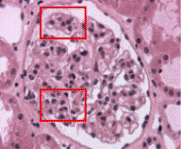
Most cases are characterized by focal and segmental mesangial proliferation (Fig. 1).


Figure 1

In approximately 20% of cases, mesangial matrix expansion and mesangial cell proliferation are particularly severe, with a morphological pattern that looks like idiopathic m embranoproliferative glomerulonephritis.

Independent of the entity of mesangial damage, the presence of a necrotizing lesion has been described by many authors. The segmental tuft necrosis can be the only lesion highlighted, possible expression of an early phase of capillary damage.

In most cases, the necrotic lesion is associated with an area of cellular extracapillary proliferation.

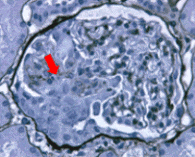
By silver staining the necrotic damage is clearly evident, with segmental destruction of the glomerular basement membrane and associated extracapillary reaction (Fig. 2).

Figure 2

By monoclonal antibodies directed against leukocytes it has been possible to demonstrate the predominant presence of monocyte-macrophages (CD68), both in the areas of necrosis and in the segmental extracapillary reaction.

In these necrotizing extracapillary forms, it is very common to find interstitial infiltrates with predominant periglomerular localization, adjacent to the areas of intraglomerular lesions.

By silver staining a possible rupture of the Bowmans capsule is clearly demonstrated, making it difficult to discriminate between intra and extraglomerular lesions (Fig. 3).

Figure 3

In our opinion, all these “active lesions” can play an important role in the progression of IgA GN, due to possible progressive “poussées” of necrotizing extracapillary damage, with consequent formation of glomerular sclerosis. The glomerular sclerotic lesions, characterized by well defined rounded areas of segmental sclerosis, represent a final reparative stage of the necrotic damage, as demonstrated in repeat biopsies (Fig. 4).

Figure 4

For this reason, many researchers believe that these forms should be treated with steroids and cyclophosphamide pulses.

In rare cases it is possible to find a diffuse extracapillary glomerulonephritis with circumferential cellular crescents in more than 60-70% of glomeruli, clinically characterized by rapidly progressive renal failure.

Marker of poor prognosis, diffuse interstitial infiltrates are commonly found in IgA GN.

Though the diagnostic “marker” of IgA GN is represented by a predominant glomerular deposition of IgA, the immunohistological pattern is variable.

An intense IgA deposition in the mesangial stalk is more common pattern (Fig. 5).

Figure 5

A mesangio-parietal pattern is also frequently observed. The parietal deposition of IgA has been associated to a worse prognosis.

By electron microscopy mesangial electron dense deposits are found in all glomeruli associated with mesangial cells proliferation (Fig. 6).


Figure 6

ww.cidpusa.org  www.cidpusa.org/P/ivig.htm  http://www.cidpusa.org/disease.html http://www.cidpusa.org/Lahore.html hair loss tips http://www.cidpusa.org/FIBROMYALGIA1.html