|
Visible Light
Waves
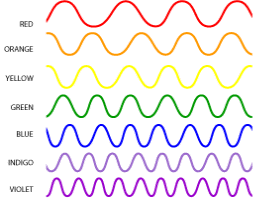
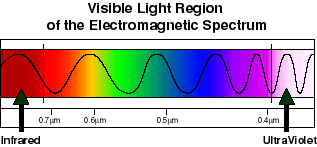
Visible light waves are the only
electromagnetic waves we can see. We see
these waves as the colors of the
rainbow. Each color has a different
wavelength. Red has the longest
wavelength and violet has the shortest
wavelength. When all the waves are seen
together, they make white light.
When white light shines through a
prism, the white light is broken apart
into the colors of the visible light
spectrum. Water vapor in the atmosphere
can also break apart wavelengths
creating a rainbow.
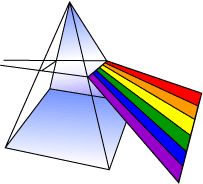
 
Each color in a
rainbow corresponds to a different
wavelength of electromagnetic spectrum.
How do we "see" using Visible Light?
|
Cones in our
eyes are receivers for these
tiny visible light waves. The
Sun is a natural source for
visible light waves and our eyes
see the reflection of this
sunlight off the objects around
us.
The color of an object that
we see is the color of light
reflected. All other colors are
absorbed.
Light bulbs are another
source of visible light waves.
|
|
| This is an
photograph taken from the space
shuttle of Phoenix, Arizona. |
  |
This is a true-color satellite
image of Phoenix, Arizona. Can
you see a difference between
this image and the photo above
it? |
|
There are two types of color images
that can be made from satellite data -
true-color and false-color. To take
true-color images, like this one, the
satellite that took it used sensors to
record data about the red, green, and
blue visible light waves that were
reflecting off the earth's surface. The
data were combined later on a computer.
The result is similar to what our eyes
see.
| Here is a false-color image
of Phoenix. How does it compare
to the true-color and space
shuttle images on this page? |
 |
A false-color image is made when the
satellite records data about brightness
of the light waves reflecting off the
Earth's surface. These brightnesses are
represented by numerical values - and
these values can then be color-coded. It
is just like painting by number! The
colors chosen to "paint" the image are
arbitrary, but they can be chosen to
either make the object look realistic,
or to help emphasize a particular
feature in the image. Astronomers can
even view a region of interest by using
software to change the contrast and
brightness on the picture, just like the
controls on a TV! Can you see a
difference in the color palettes
selected for the two images below? Both
images are of the Crab Nebula, the
remains of an exploded star!
Here's another example - the below
pictures show the planet Uranus in
true-color (on the left) and false-color
(on the right).
The true-color has been processed to
show Uranus as human eyes would see it
from the vantage point of the Voyager 2
spacecraft, and is a composite of images
taken through blue, green and orange
filters. The false color and extreme
contrast enhancement in the image on the
right, brings out subtle details in the
polar region of Uranus. The very slight
contrasts visible in true color are
greatly exaggerated here, making it
easier to studying Uranus' cloud
structure. Here, Uranus reveals a dark
polar hood surrounded by a series of
progressively lighter concentric bands.
One possible explanation is that a
brownish haze or smog, concentrated over
the pole, is arranged into bands by
zonal motions of the upper atmosphere.
What does Visible Light show us?
It is true that we
are blind to many wavelengths of light.
This makes it important to use
instruments that can detect different
wavelengths of light to help us to study
the Earth and the Universe. However,
since visible light is the part of the
electromagnetic spectrum that our eyes
can see, our whole world is oriented
around it. And many instruments that
detect visible light can see father and
more clearly than our eyes could alone.
That is why we use satellites to look at
the Earth, and telescopes to look at the
Sky!
 |
This is a
visible light image of Phoenix,
Arizona, taken from the GOES
satellite. We often use visible
light images to see clouds and
to help predict the weather. |
 |
We not only look
at the Earth from space but we
can also look at other planets
from space. This is a visible
light image of the planet
Jupiter. It is in false color -
the colors were chosen to
emphasize the cloud structure on
this banded planet - Jupiter
would not look like this to your
eyes. |
|