Experiments with light energy are making everyone
happy: farmers, doctors, patients, and astronauts
are all reaping the benefits. What began as a way to
grow better crops has ended up being a way to help
seriously ill patients recover faster. In this case,
what's good for plants is also good for people.
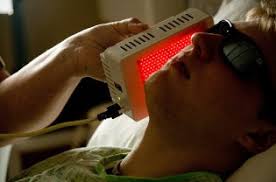
It started with Light Emitting Diodes (LEDs)
developed by NASA Marshall Space Flight Center in
Alabama and Quantum Devices, Inc., of Wisconsin. The
scientists exposed plants aboard the Space Shuttle
to the near-infrared light produced by LEDs. They
found that the LEDs increased the energy produced in
the mitochondria (energy compartments) of each cell.
That meant the cells grew faster. Faster-growing
plants are good news for farmers; the faster the
plants grow, the sooner they can be harvested,
processed, and sold.
Right
about the same time, Quantum Devices scientists
heard physicians discussing the use of laser therapy
for their patients. While laser light did accelerate
cell growth and healing in patients, there were some
significant drawbacks. Lasers can cause tissues
surrounding the treatment area to become overheated,
they're big and expensive, limited in wavelength
(color), and they're not very reliable, said Harry
T. Whelan, MD, professor of pediatric neurology and
director of hyperbaric medicine at the Medical
College of Wisconsin. A light went off, so to speak,
and Quantum approached Dr. Whelan about his
concerns. Soon they were experimenting to see if
using LED instead of laser therapy would improve the
quality of treatment for patients.
LED therapy has been used successfully with diabetic
skin ulcers, burns, and severe oral sores caused by
cancer treatment. The redder the light, the longer
the wavelength, and the longer the wavelength, the
more deeply it can penetrate body tissues, Dr.
Whalen says. The near-infrared light rays produced
by LED are longer than (and therefore superior to)
lasers, and Dr. Whelan asserts that this improved
therapy could extend to treating brain tumors and
injuries. Animal experiments being conducted now
direct LED through the head without the use of any
surgery. When LED light is used to activate
light-sensitive chemotherapy drugs to destroy cancer
it is dubbed Photo Dynamic Therapy (PDT). LED light
is otherwise used without drugs to stimulate normal
cell chemicals, for healing and tissue regeneration.
"LED reacts with cytochromes in the body," says Dr.
Whelan. "Cytochromes are the parts of cells that
respond to light and color. When cytochromes are
activated, their energy levels go up, and that
stimulates tissue growth and regeneration. The
potential to regenerate tissue, muscle, brain, and
bone opens the door to helping people with diseases
that previously had no hope of treatment." The
good news about using LED therapy to speed healing
made its way back to the space program. Muscle and
bone atrophy are well documented in astronauts
because microgravity slows the healing process, and
alters the function and structure of every cell's
mitochondria, Dr. Whelan says. The result is that
wounds are slow to heal, and muscles and bones
become weaker from time spent in space. The idea of
using LED therapy with astronauts sounded appealing
"Using an LED array to cover an astronaut may help
prevent the effects of microgravity," says Dr.
Whelan. "LED therapy could also be used to help
treat conditions that could arise in space that
don't respond to treatment because of those
microgravity situations. A simple cut might heal
faster with LED, but the benefits would be even more
notable if an astronaut suffered a severe injury."
|