|
Complete cure of FIBROMYALGIA in our E-Book and our
clinic we have the experience of treating 10,000 FMS & CFS
patients. Please see our home page.
Autoimmune diseases are on the rise. Both Fibromyalgia and
Chronic Fatigue have been considered to be autoimmune diseases. The
fact is based upon new studies which show that immune tests are
abnormal in both these conditions. Both of these diseases tend to
occur in people who have other autoimmune diseases.
There
are many ways to treat Fibromyalgia and Chronic Fatigue Syndrome
here we are presenting the immunological features of these
conditions. Where you can diagnose them by a blood tests and
treat them by IVIg .
A person is supposed to have Fibromyalgia if they have body pain
in all or one half or all of the body for at least six months. They
have tender areas in the neck, back, hips, shoulders, elbows and
knees.. The pain usually gets worse when a storm front is
approaching and the barometer falls. This is associated with body
stiffness. Will usually tend to start on the left side of the
body with complaints of vague numbness. These spells of numbness
then spread to the other side of the body.
A person with Chronic Fatigue usually
feel excessively tired. The fatigue is so severe that they have
difficulty doing things at home. Both Chronic Fatigue and Fibromyalgia can occur in the same patient at the same time. With
chronic fatigue patients tend to have excessive infections like
sinusitis, flu, bronchitis or runny nose.
Fibromyalgia and Chronic Fatigue
Syndrome are extremely common chronic condition . The
current etiologyis considered to be immune deficiency,
characteristic alterations in the pattern of sleep and changes.
The diagnosis is clinical and is characterized by widespread
pain, tender points and, commonly, comorbid conditions such as
chronic fatigue, insomnia and depression. The diagnosis can be
confirmed by doing a IgG and IgG sublass screen. Treatment is is
by using IVIg, although experience and small clinical studies
have proved the efficacy IVIg. Other less well-studied measures,
such as trigger point treatment, also appear to be helpful. Management
relies heavily on the physician's supportive counseling skills
and willingness to try novel strategies in refractory cases
Fibromyalgia is a
rheumatologic condition characterized by spontaneous, widespread
soft tissue pain, sleep disturbance, fatigue and extensively
distributed areas of tenderness known as tender points. Estimates of
prevalence are 3.4 percent for women and 0.5 percent for men.1
Fibromyalgia can be perplexing to patients and physicians because
of the lack of associated abnormalities on readily available
diagnostic tests. Despite this, recent findings about the
pathogenesis and pathophysiology of fibromyalgia have dispelled the
belief that the disorder is psychosomatic. While no laboratory test
can confirm fibromyalgia, most patients present with a history of
widespread pain, physical findings and comorbid conditions. With
experience, the disorder may be diagnosed with confidence on initial
presentation or after a period of observation and minimal diagnostic
testing. The family physician is ideally suited to treat
fibromyalgia because its management calls for a longitudinal
relationship, a willingness to try different therapeutic modalities
and an understanding of the interrelationship of the biopsychosocial
aspects of health.
Pathophysiology
While the cause of fibromyalgia is currently considered by
some to be a a immune mediated disease in some cases
assossiated with a IgG subclass deficiency.
Diagnosis
Fibromyalgia should be considered in any patient with
musculoskeletal pain that is unrelated to a clearly defined anatomic
lesion. Making the diagnosis of fibromyalgia depends on findings
from the history and physical examination rather than on diagnostic
testing.
In 1990, the American College of Rheumatology (ACR) established
criteria for classifying patients with fibromyalgia.9
However, failure to meet these criteria does not absolutely exclude
the possibility of fibromyalgia.
As with other rheumatologic disorders, fibromyalgia:
- Is established on the basis of clinical observations.
- Is a condition with signs and symptoms that exist on a
continuum.
- Often requires observation over time to firmly establish the
diagnosis.
- Some patients will have low IgG levels or low IgG subclass
levels,
History
Widespread pain is characteristic of fibromyalgia. Although not
all areas may be involved simultaneously, pain may occur in the
occiput, neck, shoulders, thoracic and lumbar spine, paraspinous
regions, buttocks, hips, elbows and knees. People complain of pain,
knots and hearing noises when they move the neck or other joints.
The complaints of numbness are vague and usually cross anatomic
boundaries.
Physical Examination
Examination will reveal areas of pain on palpation but without
the classic inflammatory signs of redness, swelling and heat in the
joints and soft tissue. Although tender points are found in many
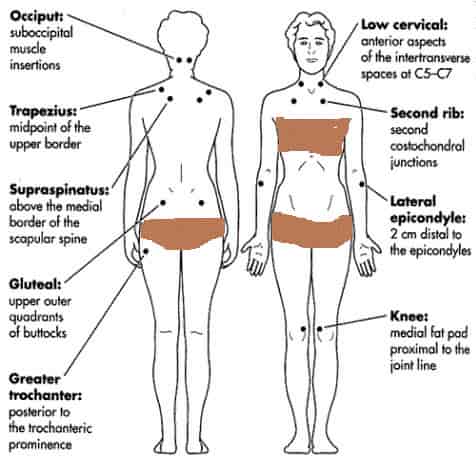
different locations, the ACR has selected 18 sites that are more
characteristic for fibromyalgia (Figure 1). To be classified
with a definitive diagnosis of fibromyalgia, the patient must have
tenderness on palpation at 11 of the 18 sites and a history as
defined in Table 1, although patients with fewer than 11
sites still may have fibromyalgia. The number of tender points may
change over time.

Skill in palpation of tender points is critical to establishing a
diagnosis of fibromyalgia. Physical findings encountered during
palpation of the soft tissues include tender points, changes in skin
texture, increased resting muscle tension and changes in the texture
of the subcutaneous tissue. The muscles are at times felt to be
stiff and hard. There may be reduced range of motion in the joints.
 |
TABLE 1
American College of Rheumatology Criteria for
Classification of Fibromyalgia
|
- Widespread pain
for at least three months, defined as the
presence of all of the following:
- Pain on the
right and left sides of the body
Pain above and below the waist (including
shoulder and buttock pain)
Pain in the axial skeleton (cervical, thoracic
or lumbar spine, or anterior chest)
- Pain on
palpation with a 4-kg force in 11 of the
following 18 sites (nine bilateral sites, for a
total of 18 sites):
- Occiput: at the
insertions of one or more of the following
muscles: trapezius, sternocleidomastoid,
splenius capitus, semispinalis capitus
Low cervical: at the anterior aspect of the
interspaces between the transverse processes of
C5-C7
Trapezius: at the midpoint of the upper border
Supraspinatus: above the scapular spine near the
medial border
Second rib: just lateral to the second
costochondral junctions
Lateral epicondyle: 2 cm distal to the lateral
epicondyle
Gluteal: at the upper outer quadrant of the
buttocks at the anterior edge of the gluteus
maximus muscle
Greater trochanter: posterior to the greater
trochanteric prominence
Knee: at the medial fat pad proximal to the
joint line
|
| Adapted with
permission from Wolfe F, Smythe HA, Yunas MB,
Bennett RM, Bombardier C, Goldenberg DL, et al. The
American College of Rheumatology 1990 criteria for
the classification of fibromyalgia. Report of the
Multicenter Criteria Committee. Arthritis Rheum
1990;33:160-72. |
 |
|
Associated Conditions
Patients with fibromyalgia often have one or more comorbid
conditions (Table 211).
Along with myofascial pain syndrome, the most common of these are
migraine headache, irritable bowel syndrome and a history of
depression and chronic fatigue.11
Although treatment for fibromyalgia may help to alleviate the
symptoms of comorbid conditions, specific treatment for these
comorbidities may be indicated.
Treatment
Because the symptoms of fibromyalgia wax and wane, treatment (as
with that of other chronic autoimmune diseases) is an ongoing process rather
than management of a single episode. Flare-ups often exacerbate the
patient's underlying stress. Furthermore, stress can also
precipitate flare-ups of fibromyalgia. Physicians should spend some
time eliciting and hearing the ongoing narrative of the struggle of
living with a chronic disease and attempt to ameliorate the effects
of the symptoms on the patient's quality of life.
For the treatment of irritable bowel syndrome just ask the person
to eat small portions of diet 6-7 times a day. Thus they cannot have
meals but only snacks.
People with Chronic Fatigue cannot do over activity. If they do
they will have to pay for it by fatigue. Then they will have
increased fatigue on the next few days. Due to immune dysfunction
they cannot metabolize in the muscles. .
|
Am J Med. 1990 Nov;89(5):561-8. |
|
A double-blind, placebo-controlled trial of
intravenous immunoglobulin therapy in patients with chronic fatigue
syndrome.
Lloyd A, Hickie I, Wakefield D, Boughton C, Dwyer J.
Department of Infectious Diseases, Prince Henry Hospital, Sydney,
Australia.
CONCLUSION: Immunomodulatory treatment with immunoglobulin is
effective in a significant number of patients with CFS, a finding
that supports the concept that an immunologic disturbance may be
important in the pathogenesis of this disorder.
PMID: 2146875 [PubMed - indexed for MEDLINE]
|
Clin Infect Dis. 2003 May 1;36(9):e100-6. Epub 2003
Apr 22. |
|
Successful intravenous immunoglobulin therapy in
3 cases of parvovirus B19-associated chronic fatigue syndrome.
Kerr JR, Cunniffe VS, Kelleher P, Bernstein RM, Bruce IN.
Department of Microbiology, Royal Brompton Hospital, Imperial
College London, Sydney St, London SW3 6NP, United Kingdom. j.kerr@imperial.ac.uk
Three cases of chronic fatigue syndrome (CFS) that followed acute
parvovirus B19 infection were treated with a 5-day course of
intravenous immunoglobulin (IVIG; 400 mg/kg per day), the only
specific treatment for parvovirus B19 infection. We examined the
influence of IVIG treatment on the production of cytokines and
chemokines in individuals with CFS due to parvovirus B19. IVIG
therapy led to clearance of parvovirus B19 viremia, resolution of
symptoms, and improvement in physical and functional ability in all
patients, as well as resolution of cytokine dysregulation.
PMID: 12715326 [PubMed - indexed for MEDLINE]
|
Am J Med. 1998 Sep 28;105(3A):43S-49S. |
|
Immunologic parameters in chronic fatigue
syndrome, major depression, and multiple sclerosis.Natelson
BH, LaManca JJ, Denny TN, Vladutiu A, Oleske J, Hill N, Bergen MT,
Korn L, Hay J.
Department of Neurosciences, Chronic Fatigue Syndrome Cooperative
Research Center, University of Medicine and Dentistry of New
Jersey--New Jersey Medical School, Newark 07018, USA.
http://www.cidpusa.org/sex%20clinic.htm |

Hair chemicals
Hair Growth
Hair of dog technique
Hair
rejuvination
Alopecia general
Nail Fungus
SESAME SEED OIL
Facial cleaner
oil pulling
AUTOIMMUNE TREATMENT
Celiac disease story
neurological
effects of CIDP
Body
goes against the grain
Celiac disease Info
More
on Celiac disease
Anemia and
celiac disease
Home for autoimmune
disorders, information about autoimmune diseases
Lahore Sex clinic
lAHORE CLINIC
Everything about IVIg, Home to
IVIg
Home to
autoimmune diseases, causes, treatment, cure, e-book
Home to autoimmune disorders , treatment , causes,
information
Fatty acids in
autoimmune diseases
AUTOIMMUNE
EPIDEMIC
Magnetic deficiency syndrome
Small fiber neuropathy
Biophosphates
memantine HCl
and muscular pains
Bio of HAKIM ABU AL
Pernicious anemia
Chemicals in
soap danger
Pet scan
Pesticide
|