Welcome to the CIDP  International organization


      Home
      Diagnosis
      Treatment
      Pathology
      Variants
      CIDP info
      GBS
        IVIG
        Diet
        About Us
        contact us
        Email Web Weaver
      Autoimmune diseases
        News
        Links


          LED

 makeup

Clinics of Excellence
 Skin repair Clinic
 Neck Pain
 Rabinder N Tagore
 Breast Lymph Drainage
 Osteoporosis
 Electronic Treatment
 Breast Size & Disease
 Female Sex Disease
 PARKINSON
 Memory problems
 Breast Lymph Drainage
 Kidney stone Buster
 Bras & breast cancer
 Lahore Clinic
 Lahore skin Clinic
 Pandas


   Clinics of Excellence

  Female sexual problems

  Breast size and disease

  Breast Lymph drainage

  Bras & breast cancer

  Breast Size and disease
 

    Clinics of Excellence

Oral Kidneystone removal  


Eliminate risk of heart disease & stroke 

Memory clinic

Depression & anxiety

Private treatment of addiction  & Drug Rehab

Sexual  disorders Clinic

Parkinson Clinic

Epilepsy Clinic

Pain Clinic

Bone disorders clinic

Joint disorder clinic

Skin repair clinic

Gene Manipulation

Neurology Clinic

TMJ CLINIC

We offer a lecture on personality development and self improvement.


Is your teenage child out of your control we do behavior modification treatment with positive results and a 90% turnaround.

Our Nanoparticle treatment units are for sale. Get your treatment at home.

Sex in autoimmune disease

Reduce weight

Drug reaction prevention

Prevent Osteoporosis

Some rheumatic disorders


For a complete guide on autoimmune treatments by antibiotics please read our e-book.


Circadian rhythms

These 24-hour cycles keep you on schedule


Sleep and Circadian Rhythms

Circadian rhythms are regular changes in mental and physical characteristics that occur in the course of a day (circadian is Latin for "around a day"). Most circadian rhythms are controlled by the body’s biological "clock." This clock, called the suprachiasmatic nucleus or SCN, is actually a pair of pinhead-sized brain structures that together contain about 20,000 neurons. The SCN rests in a part of the brain called the hypothalamus, just above the point where the optic nerves cross. Light that reaches photoreceptors in the retina (a tissue at the back of the eye) creates signals that travel along the optic nerve to the SCN.

Signals from the SCN travel to several brain regions, including the pineal gland, which responds to light-induced signals by switching off production of the hormone melatonin. The body’s level of melatonin normally increases after darkness falls, making people feel drowsy. The SCN also governs functions that are synchronized with the sleep/wake cycle, including body temperature, hormone secretion, urine production, and changes in blood pressure.

By depriving people of light and other external time cues, scientists have learned that most people’s biological clocks work on a 25-hour cycle rather than a 24-hour one. But because sunlight or other bright lights can reset the SCN, our biological cycles normally follow the 24-hour cycle of the sun, rather than our innate cycle. Circadian rhythms can be affected to some degree by almost any kind of external time cue, such as the beeping of your alarm clock, the clatter of a garbage truck, or the timing of your meals. Scientists call external time cues zeitgebers (German for "time givers").
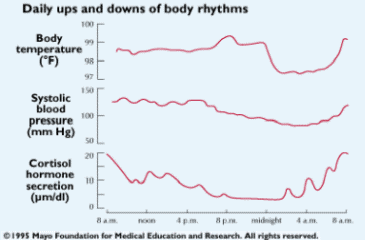


Body Rhythms


Are you sleepy sometimes in the afternoon? Do you seem to handle physical tasks more easily late in the day? If so, you already know about circadian rhythms.

Your body has more than 100 circadian rhythms. Each unique 24-hour cycle influences an aspect of your body's function, including body temperature, hormone levels, heart rate, blood pressure-- even pain threshold. Understanding how these cycles interplay is fascinating. And, in some cases, you may be able to plan your day to take advantage of your body's natural rhythms.


How your body keeps time

In your brain is a type of "pacemaker" called the suprachiasmatic (soo-prah-ki-az-MAT-ik) nuclei. This area of your brain regulates the firing of nerve cells that seem to set your circadian rhythms.

Scientists can't explain precisely how this area in your brain "keeps time." They do know your brain relies on outside influences, "zeitgebers" (ZITE-ga-berz), to keep it on a 24-hour schedule.

The most obvious zeitgeber is daylight. When daylight hits your eyes, cells in the retinas signal your brain. Other zeitgebers are sleep, social contact and even regular meal times. They all send "timekeeping" clues to your brain, helping keep your circadian rhythms running according to schedule.

Rhythms control your day

Almost no area of your body is unaffected by circadian rhythms.

Sleep and wake--It may seem you sleep when you're tired and wake when you're rested. But your sleep patterns follow a circadian rhythm.

You're most likely to sleep soundly when your temperature is lowest, in the wee hours of the morning. You're also most likely to awaken when your temperature starts to rise around 6 to 8 a.m.

As you age, your brain's "pacemaker" loses cells. This changes your circadian rhythms, especially noticeable in how you sleep. You may nap more, have disrupted sleep and awaken earlier.


Temperature--Your temperature is lowest when you're inactive. And activity can make your temperature rise. But despite these factors, your temperature also follows a definite circadian rhythm.

In the late afternoon, your temperature can be as much as 2 degrees Fahrenheit higher than in the morning. And it will rise and fall even if you never see daylight. 
Hormone production--Almost all hormones are regulated, to some extent, by circadian rhythms.

Cortisol affects many body functions, including metabolism and regulation of your immune system. Its levels are highest between 6 and 8 a.m. and gradually decline throughout the day. If you change your daily sleeping schedule, the peak of cortisol's cycle changes accordingly.

Growth hormones stimulate growth in children and help maintain muscle and connective tissue in adults. Sleep triggers hormone production, regardless of when you go to bed. Production peaks during the first two hours of sleep. If you're sleep deprived, production drops.


Cardiovascular system--More strokes and heart attacks occur in the morning than at any other time of day. This makes some people wonder if morning exercise is safe.

But experts contend morning changes in your body--not exercise-- may be responsible for cardiovascular problems. Blood clots most rapidly at about 8 a.m.

Blood pressure also rises in the morning and stays elevated until late afternoon. Then it drops off and hits its lowest point during the night.

These changes occur independently of physical activity. Exercise at any time of the day is beneficial.

On the other hand, if you're training for athletic competition, you may have reason to schedule that event later in the day. Athletes seem to perform best in the late afternoon, when strength, body temperature and flexibility peak.

Pain tolerance--Athletes who compete late in the day may perform better because they can "gain" without as much "pain." Pain tolerance is highest in the afternoon. One study shows tooth pain is lowest in the late afternoon, a consideration when you schedule your next dental appointment.

Medication--Scientists are looking at how circadian rhythms affect the way your body uses medications. One finding is that less anesthesia is needed to cause analgesia or drowsiness when administered in the afternoon.

Experiments with cancer medications are trying to find the time of day when the drugs are the most helpful with the fewest side effects.

Sex --The majority of sexual encounters took place at bedtime (11 pm to 1 am). The most common explanations for this temporal pattern is the biological clock has a time set for sexual arousal.

Heart attacks--The chances of suffering heart problems are not equal throughout the day. Heart attacks occur more often around 10 o'clock in the morning than any other time, a peak that previously was attributed to daily behavior patterns getting underway
Stay on schedule

Changes in daily habits such as a short night's sleep can disrupt your circadian rhythms. You may be able to stay "in sync" by keeping a consistent daily schedule.

Blind:

Most totally blind people have circadian rhythms that are "free-running" (i.e., that are not synchronized to environmental time cues and that oscillate on a cycle slightly longer than 24 hours). This condition causes recurrent insomnia and daytime sleepiness when the rhythms drift out of phase with the normal 24-hour cycle.10-mg dose of melatonin was given daily one hour before bedtime will achive a normal ryththm.. The dose was then reduced to 0.5 mg per day over a period of three months; the entrainment persisted, even at the lowest dose.

 Smith-Magenis syndrome.

These patients present major sleep disturbances ascribed to a phase shift of their circadian rhythm of melatonin with a paradoxical diurnal secretion of the hormone. Treatment with morning beta-blockers and evening melatonin reinstated a normally timed melatonin circadian rhythm, improved daytime behavior and restored normal sleep habits, resulting in a greatly improved quality of life for both SMS patients and their family. SMS is the demonstration of biological basis for sleep disorder in a genetic disease. Mol Cell Endocrinol. 2006 May 22 De Leersnyder H,

www.cidpusa.org  www.cidpusa.org/P/ivig.htm  http://www.cidpusa.org/disease.html http://www.cidpusa.org/Lahore.html   http://www.cidpusa.org/FMS%20CFS.html http://www.cidpusa.org/fibromyalgia.html http://www.cidpusa.org/FMS%20CFS.html
 

Clinics of Excellence

Female sexual problems

Breast size and disease

Breast Lymph drainage

Bras causing breast cancer

Breast Size and disease

    Fibromyalgia

   Autoimmune diseases

   Autoimmmune diseases 1

  Autoimmune diseases -3

  Autoimmune aneurysm

  Auto

   Autoimmune info

  Autoimmune-4

  Autoimmune-5

  Autoimmune anemia

  Autoimmune inflammation

  Autoimmune Ear

  Autoimmune Thyroid

  Autoimmune muscle

  Autoimmune diseases

  Autoimmunity

  Autoimmunity-2

  Autonomic

     Quranic Shifa

   Mercury in makeup

     Toxic Lipstick

    Toxic Baby products

    Infants  and women omega-3

    Selenium

    Female sexual problems

    Breast size and disease

    Breast Lymph drainage

    Bras causing breast cancer

    Breast Size and disease

   Backpain

   Fibromyalgia

   Personality

 Electrical Stimulation Therapy

  Addison

  Estrogen

  DNA

  Magnets and ageing

   Aortic aneurysms

   Kidney therapy

   Sex in autoimmune disease

   Reduce weight

  Drug reaction prevention

   Prevent Osteoporosis

  Some rheumatic disorders

   Personality

  Alopecia treatment

   Bald Facts

  Alopecia

   Areata Alopecia

  Hair chemicals

  Hair Growth

  Hair of dog technique

   Hair rejuvination

   Alopecia general

  Nail Fungus

  SESAME SEED OIL

  Facial  cleaner

   oil pulling