Mysterious syndrome coming in clusters
Guillain-Barre

Guillain-Barre (ghee-yan bah-ray) syndrome is a disorder in which the body's immune system attacks part of the peripheral nervous system.It usually occurs a few days or weeks after a respiratory or gastrointestinal viral infection. Occasionally, surgery or vaccinations will trigger the syndrome.
The first symptoms of this disorder include varying degrees of weakness or tingling sensations in the legs. In many instances, the weakness and abnormal sensations spread to the arms and upper body. They can increase in intensity until the muscles cannot be used at all and the patient is almost totally paralyzed.
By Richard Lake
The temporary end of a normal life started simply for Danny Beard, with pain in his ankles.
Within days, it spread to his wrists and shoulders, then into the joints all over his body.
Then his thigh muscles cramped and stopped working. It hurt so bad he cried.
Beard, then 47 , is tall and brawny, big-boned and bearded. In short, he seems invincible.
But Guillain-Barre Syndrome does not care. It affects men and women, the young and the old, the strong and the weak."We have experienced what we call a cluster of GBS cases," said Dr. Art Leis, a neurologist with Methodist Rehabilitation Center in Flowood, where Beard is among six people being treated for the strange and mystifying syndrome.
GBS, named after two French doctors who first described it in 1916, strikes about one or two of every 100,000 people annually.
It is rarely fatal, and in most cases, it will go away within a year, almost as mysteriously as it appeared.Beard is a diesel mechanic from Brandon, a hunter, a former high school football player who still carries the weight, and then some.
But this disease he had never heard of was enough to take away whatever control he thought he had over his body. It had come with no warning, no explanation, just lots and lots of pain.
"I literally cried and swallowed and hollered," he said. "I cried so hard it turned into a laugh."
GBS struck LaKeysha Greer more quietly. Greer, then 30, an attorney in Jackson, woke up in the middle of the night last September, her toes and fingers tingling. It wouldn't stop, and it hurt.
"I really feel weird," she thought.The doctors didn't know what was going on. Like they had done with Beard, they tested Greer for everything.
Within 10 days, she was paralyzed. Couldn't walk, check e-mail, or even brush her teeth.
On average, five to 10 people in the Jackson metro area come down with it a year.
The center's spokeswoman said they had treated 20 GBS patients between 2000 and mid-2005 before this new crop of six patients all showed up within a few months of each other.
Having six GBS patients at the same time is, to put it plainly, a little weird.Leis said it is still unclear if the cluster is a random, local phenomenon or if it is more widespread. Because GBS is not contagious, it is not a reportable disease. That means no one keeps track of its prevalence.
No one knows exactly what causes GBS, though it often follows a viral or bacterial infection, and sometimes follows vaccinations, surgery or stress.
Two of the six people with it here received vaccinations in the weeks before coming down with it, Leis said. The apparent connection is still unclear.
GBS is classified as an autoimmune disease meaning the body's immune system begins to attack its nervous system.
When the nerves don't work, they can't send signals to the muscles. People with GBS become paralyzed. Usually, it slowly works its way up from the feet. In the most severe cases, it even affects breathing and some patients need to be put on a ventilator.Leis likened it to a severe, paralyzing spinal cord injury.
In about 20 percent of the cases, a more serious form can develop that can last a lifetime.
Beard and Greer, though, appear to be getting better.
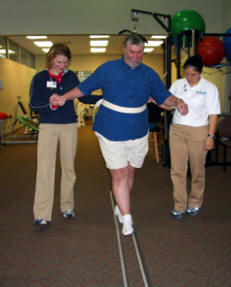
Both Beard and Greer have recently celebrated birthdays, and are going through physical therapy to get their muscles working again.
It is gruelling, they said, to have to learn to walk again, let alone figuring out how to work, manage a household and move on with their lives.Greer said she is working part-time, while Beard said his company told him his job would be there for him when he is ready.
For now, both said they're just focusing on enjoying what they took for granted before all this happened to them.
"GBS is not the type of illness that you get over quickly," Greer said. "But it is one that teaches you a little bit about your inner reserves and that, no matter what you thought before, you are strong enough to get past whatever little www.cidpusa.org/P/ivig.htm John Martin is a long-time health journalist and an editor for Priority Healthcare. His credits include overseeing health news coverage for the website of Fox Television's The Health Network, and articles for the New York Post and other consumer and trade publications.