| |
The most common pain syndrome in the world.
Read The Flame within a guide to prevent &
treat autoimmune diseases by Dr Imran Khan
Managing Myofascial Pain Syndrome
Sorting Through the Diagnosis and Honing Treatment
James M. Daniels, MD, MPH; Tim Ishmael, MD; Robert M. Wesley, MA
THE PHYSICIAN AND SPORTSMEDICINE - VOL
31 - NO. 10 - OCTOBER 2003
In Brief: Musculoskeletal complaints are among the leading
reasons for visits to physicians, and about one third of these
patients meet diagnostic criteria for myofascial pain syndrome
(MPS). Although MPS was identified more than a century ago, debate
over its existence as a separate clinical entity continues.
Physicians who learn to identify characteristic symptoms can
differentiate MPS from fibromyalgia and provide effective treatment.
Key to treatment is identification of trigger points that when
stimulated produce patterns of pain throughout a limb or region.
Treatment modalities for MPS include trigger point injection,
shiatsu, and the spray and stretch technique. Prognosis for MPS is
better than that for fibromyalgia, and treatment usually follows an
individualized regimen.
The musculoskeletal
system comprises more than 400 individual muscles and is the largest
organ system by weight in the human body.1
A recent study2
identified musculoskeletal complaints as one of the leading causes
for patients to visit a primary care provider. As many as one third
of these patients had symptoms that met the diagnostic criteria for
myofascial pain syndrome (MPS).1
Although MPS has been described variously in the literature since
1843,3
the debate over its existence continues. Whether one takes the
position that it is a subset of fibromyalgia or a separate entity,
treatment for MPS differs from that of fibromyalgia, as does its
prognosis. Patients who have MPS often have regional pain symptoms
after a relatively minor trauma or muscle overuse.
Describing and Distinguishing the Pathology
Simons et al1
have defined regional MPS as a condition in which the patient has
"hyperirritable spots" or "trigger points" within taut bands of
skeletal muscle or fascia that are painful on compression and can
give rise to characteristic referred pain, tenderness, and autonomic
nervous system symptoms. Pain from MPS can be described as deep and
achy, and it is occasionally accompanied by a sensation of burning
or stinging. Patients may also report restricted range of motion in
the area affected. MPS is limited to one area or quadrant of the
body.1
Differentiating the disorders. In 1990, the American
College of Rheumatology developed criteria for the diagnosis of
fibromyalgia,4
a condition that can sometimes be confused with MPS. MPS can be
distinguished from fibromyalgia in a number of ways (table 1).
Fibromyalgia is a disorder of sleep that affects areas throughout
the body,4
while MPS is a disorder of muscle physiology, affecting only one
region or extremity. In addition, MPS has a much better prognosis
than fibromyalgia.5,6
|
| Feature |
Trigger Points of
Myofascial Pain Syndrome |
Tender Points of
Fibromyalgia |
|
| Tender
points |
Localized |
Multiple, generalized |
|
Musculoskeletal pain |
Localized |
Generalized |
| Taut
band |
No
variation from normal |
No
variation from normal |
| Twitch
response |
No
variation from normal |
Probably normal |
|
Referred pain |
More
frequent |
Less
frequent |
|
Fatigue |
Less
frequent |
More
frequent |
| Poor
sleep |
Less
frequent |
More
frequent |
|
Paresthesia |
Less
frequent |
More
frequent |
|
Headaches |
Less
frequent |
More
frequent |
|
Irritable bowel |
Less
frequent |
More
frequent |
|
Sensation of swelling |
Less
frequent |
More
frequent |
|
|
|
|
Some clinicians are skeptical that MPS is a distinct disorder and
believe that the condition is a subset of fibromyalgia.7
The early literature on these conditions uses the two diagnoses
interchangeably. Much of the controversy centers around
differentiating the "tender points" found in patients with
fibromyalgia and the "trigger points" found in patients with MPS.
The trigger point may be associated with a local "jump response" or
"jump sign." Thus, when physicians palpate the affected muscle, they
feel a "knotted" or "doughy" area, and the patient may instinctively
recoil or jump when the area is identified. A tender point
associated with fibromyalgia may not be detected when palpated and
may represent only an area of maximum tenderness within a sore
muscle. Tender points are not associated with referred pain
patterns, jump signs, or the motor endplates of the muscle-nerve
interface.
One study7
employed clinical experts to perform tender point examinations on
three groups of patients. A small number of patients were
prediagnosed with either fibromyalgia or MPS. These patients were
compared with 80 "healthy" patients. The experts found taut bands of
muscle and muscle twitches in both healthy controls and in patients
with either of the conditions. A liberal definition of "trigger
points" by these investigators produced overlap between the
fibromyalgia group and the MPS group, and local areas of tenderness
or "tender spots" were found in both groups.7
A second study8
of similar design found that dolorimetry and palpation were very
reliable in discriminating between control patients and those with
MPS or fibromyalgia.
Muscle Basics, Trigger Points, and Pain Patterns
A review of structural and physiologic principles of muscle
contraction helps address syndrome etiology and provides tips on
trigger point identification.
Muscle structure and contraction. Skeletal muscle is an
assembly of fascicles, each of which is a bundle of roughly 100
muscle fibers. Each muscle fiber or cell encloses approximately
1,000 to 2,000 myofibrils. Myofibrils consist of chains of
sarcomeres connected serially, end-to-end. Individual sarcomeres are
basic contractile units of skeletal muscle connected by z-lines,
often described as "links in a chain" when visualized under the
microscope. Each sarcomere is composed of actin and myosin molecules
that form cross-bridges in the presence of ionized calcium.
When adenosine triphosphate (ATP) is bound to myosin, the
actin-myosin cross-bridge remains relaxed (not attached). Hydrolysis
of ATP into adenosine diphosphate (ADP) results in the interaction
or crossbridging of the actin and myosin proteins. ADP then
dissociates from the myosin, causing it to bend or "cock," thus
pulling on the actin and shortening the sarcomere. Reattachment of
another ATP releases the cross-bridge and uncocks the myosin,
allowing the process to start over. As these cycles are repeated,
the muscle contracts. When calcium is removed, the contraction is
terminated. Without additional ATP input, the cross-bridges remain
attached, myosin stays cocked, and the muscle is stiff, as in rigor
mortis.9
It is key that the muscle can continue to expend energy in the
presence of calcium when the muscle is at its shortest length and
that maximum overlap exists between actin and myosin fibers. A
deficit in calcium metabolism at the sarcoplasmic reticulum can
cause a "trigger point" in a resting muscle.
The muscle fibers normally receive their nerve supply from a
motor neuron via a motor end plate. Calcium release through the
sarcoplasmic reticulum is controlled through the release of
acetylcholine at the motor end plate.9
Clinically, it is important to understand that end plates are
usually located in the center of the muscle fiber. Since trigger
points characteristic of MPS are intimately involved with these
motor end points, the orientation of the muscle fibers within the
muscles affects the pain pathway.
In MPS, palpating the muscle is painful. The pain is relieved by
stretching the sarcomere and restoring the muscle to its normal
length by removing the overlap between the actin and myosin
filaments.10
Such stretching is exquisitely painful and requires temporarily
blocking pain receptors while the involved muscle is stretched. This
phenomenon is the reason that spray and stretch, local injection,
and acupressure—all of which inhibit pain and motor reflex—are
employed in treatment as the muscle is stretched to length.
Although many theories responsible for MPS have been postulated,5,11
no clear causal factors have been identified. Clinical studies have
shown some association between MPS and prolonged static postures,
lack of exercise, sleep disturbance, and emotional stress.5
With minimal training, clinicians can identify this syndrome based
solely on history and physical examination findings.
Identifying trigger points. The recommended criteria for
identifying trigger points consist of essential criteria and
confirmatory observations (table 2).1
Using pain diagrams, examiners can compare patient trigger points
identified with those known from published drawings (figure 1).5,10,12,13
|
Essential Criteria
Taut band palpable (if muscle is accessible)
Exquisite spot tenderness of a nodule in a taut
band
Patient's recognition of current pain complaint
by pressure on the tender nodule (identifies active
trigger point)
Painful limit to full passive stretch range of
motion
Confirmatory Observations
Visual or tactile identification of local twitch
response
Observation of a local twitch response induced by
needle penetration of a tender nodule
Pain or altered sensation (in the distribution
expected from a trigger point in that muscle) on
compression of a tender nodule
Electromyographic demonstration of spontaneous
electrical activity characteristic of active loci in
the tender nodule of a taut band
HRT = hormone replacement therapy; MI =
myocardial infarction; BP = blood pressure; HDL =
high-density lipoprotein cholesterol |
|
|
Trigger points are subdivided into two groups. Active trigger
points cause referred pain and usually have predictable patterns
specific to each muscle. These trigger points are rarely located
where the patient reports the pain. The pain pattern does not
usually follow a specific dermatomal pattern. The suspected muscle
should be palpated until a band or feeling of tightness is located.
This finding is often described as a ropiness or nodularity in the
muscle. Clinicians should then apply pressure until they find the
"spot of maximum tenderness" along the length of the taut band of
muscle fiber.14
When the trigger point is palpated, the patient may localize the
discomfort and involuntarily withdraw from contact (jump sign).1
Such a finding is a strong indication of a trigger point. Sustained
digital pressure on a trigger point usually evokes the same referred
pain pattern that brought the patient into the clinic. Occasionally,
anatomically controlled phenomena, such as a change in skin
temperature, color, or perspiration, may occur.
The second type of myofascial trigger point that Travell15
describes is the latent trigger point. On exam, the patient may have
a nodular area that, while associated with a taut band of muscle,
does not reproduce pain. This finding, along with increased muscle
tension and a restricted range of motion, separates this particular
myofascial trigger point from the tender points that are
characteristic of fibromyalgia.
Treating Trigger Points
After identifying the characteristic trigger points of MPS and
ruling out other diagnoses, various treatment protocols can be
implemented in an office setting.
Trigger point injections. Various compounds have been
described16,17
for use in injections, including 3% promethazine-hydrochloride, 0.5%
procaine hydrochloride, 1% lidocaine hydrochloride without
vasoconstrictors, and 0.25% lidocaine with normal saline.
Indications for trigger point injections are a limited number of
tender spots coinciding with the patient's complaint that produce
the jump sign in response to pressure.18
Several contraindications for injections have been proposed (table
3).18
|
Do Not Inject Patients
Who Have:
A bleeding disorder or are on anticoagulant
therapy
An eating disorder
Taken aspirin within 3 days
A local or systemic infection
Allergies to local anesthesia
An inordinate fear of needles |
|
The International Association for the Study of Pain has made
suggestions for training to identify trigger points and has
published recommended standards for injecting trigger points.17
Many experienced primary care physicians are skilled in performing
injections, but physicians should be aware of the following caveats:
- To avoid pneumothorax, never aim the needle at an
intercostal space. (Even with proper training and patient
informed consent, we do not advocate injection in this area for
outpatients.)
- Use a needle long enough to keep the hub well above the skin
surface during injection.
- Never inject the needle to the hub, because, if the needle
breaks, complications can arise.
- Be aware of the tip of the needle at all times and avoid
placing any sideward pressure on the syringe that could bend the
needle and deflect the tip.
- Check for a needle that has a rough tip surface, which may
create a "drag" upon injection; the impact of the tip of such a
needle produces a fish-hook burr, causing unnecessary bleeding.17
Needles can be replaced if a rough tip is found, even after the
syringe is filled.
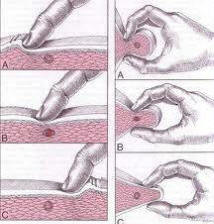
Shiatsu. This technique has many names, including ischemic
acupressure and mild therapy. To perform the technique, the
clinician uses the thumb to apply a slow, gentle, firm pressure to
the trigger point. It is very important that light pressure be
applied initially and slowly intensified over approximately 1
minute; application of sudden forceful pressure will actually
aggravate the patient's symptoms. A second minute of maximal
pressure is applied, at which time the examiner's thumb is slowly
released from the trigger point. Clinicians familiar with this
technique often describe a feeling of the muscle "giving way"
beneath their fingers during this second minute. Once pressure is
released, the skin blanches briefly, and a reactive hyperemia
follows that may last several hours. This technique has no known
complications other than local ecchymosis in some patients.19
Spray and stretch. Not all patients can tolerate ischemic
acupressure, so some practitioners may employ a spray and stretch
technique with vapocoolant.17
The pain signal sent by the stretched muscle is overridden by a
nerve impulse to the posterior horn of the spinal column. Following
identification of the trigger point, the physician places the
patient in a comfortable, relaxed position. To prepare the patient,
physicians may often use a heating pad or moist heat on the area for
approximately 5 to 10 minutes. One end of the muscle is anchored
either by one of the examiner's hands or by immobilizing the
patient's distal appendage. The skin is then sprayed with repeated
parallel sweeps of vapocoolant over the length of the muscle in the
direction of the pain pattern (figure 2). It is important that the
vapocoolant container be held approximately 12 in. (30 cm) from the
skin at a 30° angle to the plane of the skin. Parallel sprays are
made using unidirectional sweeps over the most tightly stretched
muscle fibers and then over the rest of the muscle. Sweeps should be
slow and even and cover about 4 in./sec (10 cm/sec). The spray
should be overlapped slightly, but no more than two passes should be
made over the same area.20
After the first sweep of spray, pressure is applied to take up
muscle slack; this pattern is continued as additional sweeps of
spray are applied. The sweeps are extended to cover the referred
pain pattern of the muscle. These steps are repeated two or three
times until the skin becomes cold to the touch or when range of
motion reaches its maximum. Reapplication of heat is followed by
several cycles of full range of motion of that muscle. Some
physicians suggest using the vapocoolant over a slightly larger area
than that of the referred pain pattern. If the patient says the
spray is too cold, the dispenser can be held closer to the skin than
the usual 12 in. (30 cm). If a colder than usual spray is desired,
distance can be increased to 18 in. (46 cm). The skin should be
transiently cooled and not the underlying muscle. Passive stretching
is gradually applied to get the joint to extend to its full range of
motion, but the muscle should not be overstretched. The muscle
should then be promptly returned to its shortened length.21
Coolant use and ice stroking. In the past, the most widely
used vapocoolant was ethyl chloride, but this has been replaced by
fluoromethane, which is nontoxic, is nonflammable, and does not
irritate the skin. Unfortunately, fluorocarbons have been implicated
in degradation of the upper atmosphere ozone layer and will no
longer be manufactured. A temporary medical exception was granted
for fluoromethane until a suitable substitute is developed, and one
such spray is available (Fluori-Methane Spray and Stretch, Gebauer,
Cleveland, 1-800-321-9348). The concentrated stream from a
vapocoolant dispenser is far superior to the usual diffuse spray
from a standard spray can. Physicians should be careful when using
fluoromethane. Although the spray will not damage most tissues that
are accidentally sprayed, the conjunctiva may be damaged if the
spray hits a patient's eye.
Some patients with cold-induced asthma or other respiratory
conditions may not tolerate vapocoolant spray near the face unless
the clinician covers the patient's nose with a small cloth or hand.22
This difficulty has led to the development of a technique called ice
stroking, which may replace spray for these patients. Water is
frozen in a plastic or paper cup with a stirring stick, such as a
tongue depressor, placed in the cup to provide a handle to hold the
ice. The bottom of the cup is then torn back and an edge of ice is
applied to the skin in a unidirectional stroke following the same
patterns as for the spray. The patient's skin must remain dry,
because dampness alters the rate of change in skin temperature. Some
clinicians cover the ice with thin plastic wrap or have an assistant
follow along with a small towel to blot the skin. It is imperative
to move along at a rate so that the ice cools just the skin and not
the underlying tissues.1
These techniques can be easily mastered in a short time. The only
contraindications to these methods would be if the patient has
Raynaud's phenomenon, cold urticaria, or hypersensitivity to one of
the cooling agents.
Battling Underdiagnosis
MPS is a common disorder that may be underdiagnosed. It is
imperative that the physician has determined that the patient has no
other condition that mimics MPS. Some of the simple techniques
described for treating MPS can be easily learned by patients to
provide pain relief and restore function without the additional cost
of supervised physical therapy and medications.
References
- Simons DG, Travell JG, Simons LS, et al: Travell & Simons'
Myofascial Pain and Dysfunction: The Trigger Point Manual, ed 2.
Baltimore, Williams & Wilkins, 1999, p 132
- Skootsky SA, Jaeger B, Oye RK: Prevalence of myofascial pain
in general internal medicine practice. West J Med
1989;151(2):157-160
- Kellgren JH: A preliminary account of referred pains arising
from muscle. BMJ 1938;1:325-327
- Wolfe F, Smythe HA, Yunus MB, et al: The American College of
Rheumatology 1990 criteria for the classification of
fibromyalgia: report of the Multicenter Criteria Committee.
Arthritis Rheum 1990;33(2):160-172
- Han SC, Harrison P: Myofascial pain syndrome and
trigger-point management. Reg Anesth 1997;22(1):89-101
- Jaeger B, Reeves JL: Quantification of changes in myofascial
trigger point sensitivity with the pressure algometer following
passive stretch. Pain 1986;27(2):203-210
- Wolfe F, Simons DG, Fricton J, et al: The fibromyalgia and
myofascial pain syndromes: a preliminary study of tender points
and trigger points in persons with fibromyalgia, myofascial pain
syndrome and no disease. J Rheumatol 1992;19(6):944-951
- Tunks E, McCain GA, Hart LE, et al: The reliability of
examination for tenderness in patients with myofascial pain,
chronic fibromyalgia and controls. J Rheumatol
1995;22(5):944-952
- Mountcastle VB (ed): Medical Physiology, ed 14. St Louis,
Mosby-Yearbook, 1980, pp 82-119
- Fricton JR, Auvinen MD, Dykstra D, et al: Myofascial pain
syndrome: electromyographic changes associated with local twitch
response. Arch Phys Med Rehabil 1985;66(5):314-317
- Fine PG, Milano R, Hare BD: The effects of myofascial
trigger point injections are naloxone reversible. Pain
1988;32(1):15-20
- Rachlin ES: History and physical examination for regional
myofascial pain syndrome, in Rachlin ES (ed): Myofascial Pain
and Fibromyalgia: Trigger Point Management. St Louis,
Mosby-Yearbook, 1994, pp 159-172
- Simons DG, Travell JG: Myofascial origins of low back pain:
1. Principles of diagnosis and treatment. Postgrad Med
1983;73(2):66-77
- Price DD, McGrath PA, Rafii A, et al: The validation of
visual analogue scales as ratio scale measures for chronic and
experimental pain. Pain 1983;17(1):45-56
- Travell J: Identification of myofascial trigger point
syndromes: a case of atypical facial neuralgia. Arch Phys Med
Rehabil 1981;62(3):100-106
- Wolf SL, Minkwitz JA: Topical anesthetics: effects on the
Achilles tendon and H-reflexes. 2. Stroke patients. Arch Phys
Med Rehabil 1989;70(9):673-677
- Fields HL (ed): Core curriculum for professional education
in pain: a report of the Task Force on Professional Education of
the International Association for the Study of Pain. Seattle,
IASP Press, 1995
- McClaflin RR: Myofascial pain syndrome: primary care
strategies for early intervention. Postgrad Med 1994;96(2):56-73
- Chan P: Finger Acupressure: Treatment for Many Common
Ailments from Insomnia to Impotence by Using Finger Massage on
Acupuncture Points. New York City, Ballantine Books, 1975
- Nielsen AJ: Spray and stretch for myofascial pain. Phys Ther
1978;58(5):567-569
- Halkovich LR, Personius WJ, Clamann HP, et al: Effect of
Fluori-Methane spray on passive hip flexion. Phys Ther
1981;61(2):185-189
- Mense S, Simons DG, Russell IJ: Muscle Pain: Understanding
Its Nature, Diagnosis, and Treatment. Philadelphia, Lippincott
Williams & Williams, 2001, p 299
Dr Daniels is associate professor of family and community
medicine in Southern Illinois University School of Medicine's family
practice residency program and program director of the care sports
medicine fellowship program in Quincy, Illinois. He has a
certificate of added qualifications in primary care sports medicine.
Dr Ishmael is a family practice physician in private practice in
Litchfield, Illinois. Mr Wesley is director of research and program
development in the department of family and community medicine at
the Southern Illinois University School of Medicine in Springfield,
Illinois. Address correspondence to James M. Daniels, MD,
MPH, 612 N 11th St, Suite B, Quincy, IL 62301;
|
 |